Moral alignment test: the alignment chart that checks
Anyone can say they’re Lawful Good. This alignment chart test checks: five dilemmas with people watching, then the same five alone in the dark. Free, no sign-up, silly on purpose.WatchedAlone
How the test works
Point to where you think you stand on the nine-box chart. That goes on the record.
Play five small dilemmas in daylight, each with someone looking on: a store attendant, a park ranger, the whole office.
The lights go out. The same five dilemmas come back with nobody there, the same answers in a new order. One answer now takes a single tap, and every other one has to be pressed and held.
See the square you landed on in the dark, where you stood in daylight, and the receipts for every answer you changed.
Send it to a friend. They guess your square, then play. Find out which of you gets the house keys.
An alignment chart is a three-by-three grid. Across the top, how you treat rules: lawful, neutral or chaotic. Down the side, who it’s for: good, neutral or evil. Tap a square to read what it means.
These are fans’ placements, gathered from published guides such as this one and this one. They’re opinions, and the guides don’t agree: those two put Voldemort on Neutral Evil and Chaotic Evil. That argument is half the fun.
The Joker, Bellatrix Lestrange, Freddy Krueger, Anton Chigurh
Alignment chart maker
Type nine names, save the picture, start the argument. It all stays in your browser. Sort your friends, your exes’ cars, or every way of loading a dishwasher. Or grab the blank chart above and fill it in by hand.
Fill the corners first. Those are the easy arguments.
Save the middle for last. True Neutral is where the real fight is.
Swap the lines if you like: purist to rebel works, as does tidy to feral.
The nine alignments explained
Lawful Good
The Cart Returner
Lawful Good means doing the right thing by the rules: you believe rules exist to protect people, and you keep them even when it costs you.
In real life
Reads the sign, follows the sign, and reports the sign if it’s wrong
Returns the extra change and the cart
Is the friend you call from jail, who is disappointed and also brings bail
How it goes wrong, and who it clashes with
How it goes wrong
The lecture that comes free with the help. At its worst it stops asking who a rule is hurting, and defends the rule anyway.
How it differs from its neighbors
Neutral Good does the kind thing and ignores the paperwork. Lawful Neutral does the paperwork and doesn’t ask if it’s kind. This square insists on both.
Gets along with
Neutral Good. You want the same outcome. They’ll skip the form and you’ll quietly file it.
Clashes with
Chaotic Good. Both sure they’re the good one. Every disagreement is about method, and it never ends.
Neutral Good
The Quiet Favor
Neutral Good means wanting people to be okay and not being fussy about how: you follow a rule when it helps and step around it when it doesn’t.
In real life
Does the favor and doesn’t mention it
Bends a policy for someone having a bad day
Remembers your coffee order and your mother’s surgery date
How it goes wrong, and who it clashes with
How it goes wrong
Never saying what you want, then keeping a private list of everything you’ve done for people. A favor nobody knows about can be a kind of power.
How it differs from its neighbors
Lawful Good would report the mistake and then pay the fine for you. Chaotic Good would enjoy misleading the authorities. This square just wants the outcome.
Gets along with
Lawful Good. They bring the plan, you bring the mercy.
Clashes with
Neutral Evil. You keep doing them favors. They keep accepting.
Chaotic Good
The Kind Menace
Chaotic Good means trusting your own conscience over any rule: you’ll break one for someone else’s sake, and you won’t ask permission first.
In real life
Sneaks food into the movies for the whole row
Argues with the manager on behalf of a stranger
Has been asked to leave somewhere, for a good reason
How it goes wrong, and who it clashes with
How it goes wrong
Mistaking “I broke a rule” for “I did good”. The rule-breaking becomes the point, and the person it was for gets forgotten.
How it differs from its neighbors
Neutral Good steps around a rule quietly. This square would rather the rule knew. Chaotic Neutral breaks the same rule with no one in mind at all.
Gets along with
Chaotic Neutral. Great trip, no itinerary, one arrest between you.
Lawful Neutral means keeping the rule because it’s the rule, whoever it helps or hurts: order first, and feelings can fill out a form.
In real life
Reads the whole contract, then the appendix
Won’t cross on red at 3 a.m. on an empty street
Has a chore chart, and it’s laminated
How it goes wrong, and who it clashes with
How it goes wrong
Doing real harm with a clear conscience, because the form was filled out correctly.
How it differs from its neighbors
Lawful Good asks who the rule is for. Lawful Evil asks what the rule can do for them. This square doesn’t ask.
Gets along with
True Neutral. You make the rules, they don’t mind. Very quiet house.
Clashes with
Chaotic Neutral. Every shared calendar you’ve ever made has died at their hands.
True Neutral
The Shrug
True Neutral means sitting in the middle of both lines: either wisely balanced, weighing each case as it comes, or simply not that bothered.
In real life
Has no team in this fight and would like to keep it that way
Says “it depends” and means it
Votes for whichever restaurant is closest
How it goes wrong, and who it clashes with
How it goes wrong
Calling it balance when it’s avoidance. Someone needed you to pick a side, and you stayed out of it.
How it differs from its neighbors
Every other square wants something. Lawful Neutral wants order, Chaotic Neutral wants freedom, Neutral Good wants people to be okay. This one is waiting to see.
Gets along with
Lawful Neutral. They decide, you’re fine with it. Everyone’s happy, technically.
Clashes with
Chaotic Evil. You’d like one peaceful afternoon. They’ve brought matches.
Chaotic Neutral
The Runaway Cart
Chaotic Neutral means following the mood of the moment: you’re not out to hurt or help anyone, you just won’t be told.
In real life
Quits a job by not going back from lunch
Takes the scenic route, then a different one
Has a plan until someone asks about it
How it goes wrong, and who it clashes with
How it goes wrong
Calling it freedom while other people clean up. Being unpredictable is only fun for one person in the room.
How it differs from its neighbors
Chaotic Good breaks the rule for someone. Chaotic Evil breaks it at someone. This square breaks it because it was there.
Gets along with
Chaotic Good. They bring the cause, you bring the getaway idea.
Clashes with
Lawful Neutral. They’d like to know where you were. So would you.
Lawful Evil
The Polite Villain
Lawful Evil means keeping every rule and aiming them all: everything you do is technically allowed, and that’s exactly what’s wrong with it.
In real life
Reports a coworker to HR, with timestamps
Wins the HOA vote on a technicality
Sends “per my last email” and enjoys it
How it goes wrong, and who it clashes with
How it goes wrong
It mostly goes right for them. It goes wrong for the person reading the fine print too late.
How it differs from its neighbors
Lawful Neutral follows the contract because it’s the contract. This square wrote it. Neutral Evil would simply lie, and thinks all this paperwork is showing off.
Gets along with
Neutral Evil. You draw up the deal, they find the victim. It’ll end badly, in writing.
Clashes with
Chaotic Evil. You had a plan. They set it on fire to see what color it burned.
Neutral Evil
The Last Slice
Neutral Evil means being out for yourself, with no loyalty to rules or to breaking them: a rule is useful until it isn’t.
In real life
Takes credit in the meeting, quietly
Is suddenly busy on moving day
Remembers exactly who owes them
How it goes wrong, and who it clashes with
How it goes wrong
Nobody trusts you twice. It’s a strategy that works once per person.
How it differs from its neighbors
Lawful Evil needs the rules. Chaotic Evil enjoys the mess. This square doesn’t care for either, as long as it gets the slice.
Gets along with
Lawful Evil. A good partnership right up to the moment one of you cashes out.
Clashes with
Neutral Good. They do favors. You collect them. They’ll figure it out eventually.
Chaotic Evil
The Dumpster Fire
Chaotic Evil means wanting what you want, right now, and enjoying the mess: no plan, no loyalty, and no interest in who cleans up.
In real life
Replies all
Keys a car because it’s Tuesday
Leaves one second of microwave time on the clock, on purpose
How it goes wrong, and who it clashes with
How it goes wrong
It burns down the place it lives in. Everyone else has a reason to keep things standing, even the villains.
How it differs from its neighbors
Neutral Evil is quiet about it, because quiet pays. Chaotic Neutral makes a mess by accident. This square does it on purpose and stays to watch.
Gets along with
Chaotic Neutral. They wandered in by accident. You’re the reason they can’t leave.
Clashes with
Lawful Evil. They’d like you to sign something. You’ve eaten the pen.
Lawful doesn’t mean good, and chaotic doesn’t mean bad
The two lines measure different things, which is why the chart has nine squares and not three. Law to chaos is about method: do you trust the rule, or your own judgment? Good to evil is about motive: is this for other people, or for you?
So a tax auditor who loves the paperwork and a villain who has read every clause are both lawful. A friend who sneaks you an extra cookie and a person who sets a dumpster on fire are both chaotic. Most arguments about a character’s alignment are really about which of the two lines you’re looking at.
Why this test asks everything twice
Lights out
Anyone can be Lawful Good with the whole team in the kitchen. The interesting question is who eats the brownie after they’ve gone home, so that’s what this moral alignment test measures. The two rounds use the same situations and the same four answers. What changes is the audience, and how hard the easy answer pulls.
Around 2,400 years ago, in the second book of Plato’s Republic, Glaucon tells the story of the Ring of Gyges: a shepherd finds a ring that makes him invisible, and uses it badly. Glaucon’s point is that anyone would. Take away the risk of being seen, and what’s left of being good? Socrates spends much of the rest of the Republic arguing back.
Psychologists have tried a smaller version. In a Newcastle University coffee room with an honesty box, people paid nearly three times as much in the weeks a poster above it showed a pair of eyes rather than flowers. It’s a famous result and an argued-over one: two later meta-analyses found that pictures of eyes don’t reliably make people more generous. Nobody has settled it, which is a good reason to try it on yourself.
Alignment test questions: two worked examples
Most alignment tests ask what you’d do. This one asks twice, and the second time it makes it harder. Here are two of the fifteen situations as you’d see them, with the way each answer leans. In the test the leaning is hidden, and the answers come back in a different order in the dark, so you can’t just tap the same place.
The brownie
With people watching
A coworker is crying in the office kitchen and hasn’t eaten all day. The only food is a brownie labeled DAN. Everyone can see you.
With nobody watching
A coworker is crying down the hall, late at night. The only food is a brownie labeled DAN. Dan’s gone home, and it smells incredible.
Answer
Which way it leans
Hand it over. Dan will live
Chaotic Good
Eat it, and leave a signed IOU
Lawful Evil
Shut the fridge. It’s Dan’s
Lawful Neutral
Run out and buy them something
Neutral Good
The shopping cart
With people watching
It’s pouring, the cart return is a long way off, and your neighbor is watching from their car.
With nobody watching
It’s pouring, the cart return is a long way off, the parking lot is empty, and your ride just pulled up.
Answer
Which way it leans
Walk it back, and a stray one too
Lawful Good
Give it a push and wish it luck
Chaotic Neutral
Leave it. Someone’s paid to do this
Neutral Evil
Park it neatly by a light pole
True Neutral
What the studies say about being watched
In 1997, C. Daniel Batson and colleagues asked students to decide who got a pleasant task: themselves, or a stranger. In one of the studies half chose to flip a coin to settle it fairly, and nine of those ten still ended up with the nice task. Nobody could check the coin. The authors’ name for it was moral hypocrisy: wanting to look fair, more than wanting to be fair. The studies were small, so take the exact numbers lightly.
Darkness may do the same job as a coin nobody can check. In a 2010 paper called “Good Lamps Are the Best Police”, people in a dimly lit room cheated more on a task they marked themselves than people in a well-lit one, and in a later experiment wearing sunglasses was enough to make people more self-interested. A pre-registered replication in 2023 used a coin-toss task and again found more dishonesty in the dark, but it didn’t support the idea that feeling anonymous was the reason. So the lights seem to matter, and why is still open.
There’s a reason round two comes after round one. Moral self-licensing is the idea that doing something good makes it feel easier to do something less good next. A meta-analysis of 91 studies with 7,397 people found a real but modest effect, and a larger one in published studies than in unpublished ones, which is a reason for caution. This test can’t measure any of that in you. It can show you the two rounds side by side, which is more than most of us get.
How your square is worked out
No secret sauce. Each of the ten dilemma answers moves you along two lines: the rule kept or broken, and who it was for. A plain answer moves one line two steps and leaves the other alone, and a mixed answer moves each line one step. Five cards make the daylight score and five make the dark one. On either line, two steps or more away from the middle puts you on that side. Anything closer stays neutral, because one stray answer isn’t a side.
The first card, the lights-out card and the oath never move you. The oath does change what the result says: answer “as who I’d like to be” and a Lawful Good result is read as an ambition, not a fact. Give the same answers in both rounds and you’ll land on the same square both times, so any move on the chart is one you made. If you swing hard both ways and cancel out, you’re still True Neutral on paper, but the result will tell you that isn’t the same as not caring.
Where the alignment chart came from
The chart comes from Dungeons & Dragons. The 1974 game had one line, law against chaos, with neutral between them, and Gary Gygax credited the idea to the fantasy stories of Michael Moorcock and Poul Anderson. In the later 1970s he added a second line, good against evil, and two lines make nine squares. The game has changed its mind since, cutting them to five in its 2008 edition and bringing back all nine in 2014.
Then the chart escaped. Alignment charts became an internet format, and since around 2018 people have used them to sort anything: film characters, celebrities, animals, sandwiches. That’s why so many people who have never rolled a die can tell you what Chaotic Neutral means.
Better with someone who knows you
Choose On this phone and pass it over, or Send a link. Each of you guesses where the other will land, you both play the same cards, and the result puts you both on one chart: what each of you claimed, who guessed right, who changed the most in the dark, and a question to ask each other wherever you split. Or share your result sealed: your friend gets a guess before they see your square. The cards change each time you play, and this phone keeps your chart of the squares you’ve visited, ready to save as a picture.
Questions people ask
What is my moral alignment?
Your place on a nine-box chart: lawful, neutral or chaotic on one line, good, neutral or evil on the other. Take the test above and you’ll get two answers, the one you show people and the one you land on alone.
What’s the difference between Lawful Evil and Chaotic Evil?
Both are out for themselves. Lawful Evil uses the rules as a weapon, so everything it does is technically allowed. Chaotic Evil doesn’t care that there are rules at all.
What does True Neutral mean?
You sit in the middle of both lines. Either you’re wisely balanced, or you’re not that bothered. It’s also where you land if your answers pull both ways.
What does Chaotic Neutral mean?
You do what feels right in the moment, with no great plan to help or harm. You’re not against anyone. You just won’t be told.
What does Lawful Good mean?
You believe rules protect people, and you keep them even when it costs you. The Lawful Good person pays for the cheese the machine missed. The risk is defending a rule after it has stopped helping anyone.
What does Neutral Good mean?
You want people to be okay and you aren’t fussy about the method. You follow a rule when it helps and step around it when it doesn’t.
What does Chaotic Good mean?
You trust your own conscience over any sign or manager. You’ll break a rule for someone else’s sake, and you’re often right, and rarely thanked.
What does Lawful Neutral mean?
You keep the rule because it’s the rule, whoever it helps or hurts. Reliable to a fault. Fans often put Judge Dredd here.
What does Lawful Evil mean?
You keep every rule and use them to get what you want. Everything you do is technically allowed, which is exactly the problem.
What does Neutral Evil mean?
You’re out for yourself, with no loyalty to rules or to breaking them. You’ll keep a rule when it’s useful, drop it when it isn’t, and avoid a scene either way.
What does Chaotic Evil mean?
You want what you want, now, and you enjoy the mess. There’s no plan and no loyalty, which makes it the funniest square to land on and the worst to live with.
What are moral alignment test questions like?
Here they’re small everyday dilemmas: the self-checkout that didn’t scan your cheese, the shopping cart in the rain, a friend’s terrible haircut. Each one comes twice, watched and then alone. Two are written out in full above.
Which alignment is the best?
The chart doesn’t say. Lawful Good and Chaotic Good disagree about almost everything, and each thinks it’s the good one. The worst to live with is a matter of opinion, though Chaotic Evil is a strong candidate.
What’s the most common alignment?
We only count squares from this test, and only show a square once at least ten people have landed there. When there’s a real count, it’s under the chart at the top of this page. Until then, any number here would be made up.
Can your alignment change?
In this test it can change within thirteen cards, which is the point. It depends who’s watching and what’s on the table. Play again and you’ll get different situations. This phone keeps a note of the squares you’ve visited.
Is this a real psychological test?
No. It’s a joke with a chart, and it says nothing true about your character. For something closer to real psychology, try the Big Five test on this site.
Is this an official Dungeons & Dragons test?
No. The two-line chart comes from that game, but this test, its characters and its dilemmas are our own, and we’re not connected with the game’s publisher. It won’t tell you how to play your character.
Do you store my answers?
If you play alone or on one phone, your answers stay on it. We only count, anonymously, which square you landed on and how many answers you changed. If you send a link, your first name and answers are kept for 30 days so the other person can compare, or they travel inside the link itself.
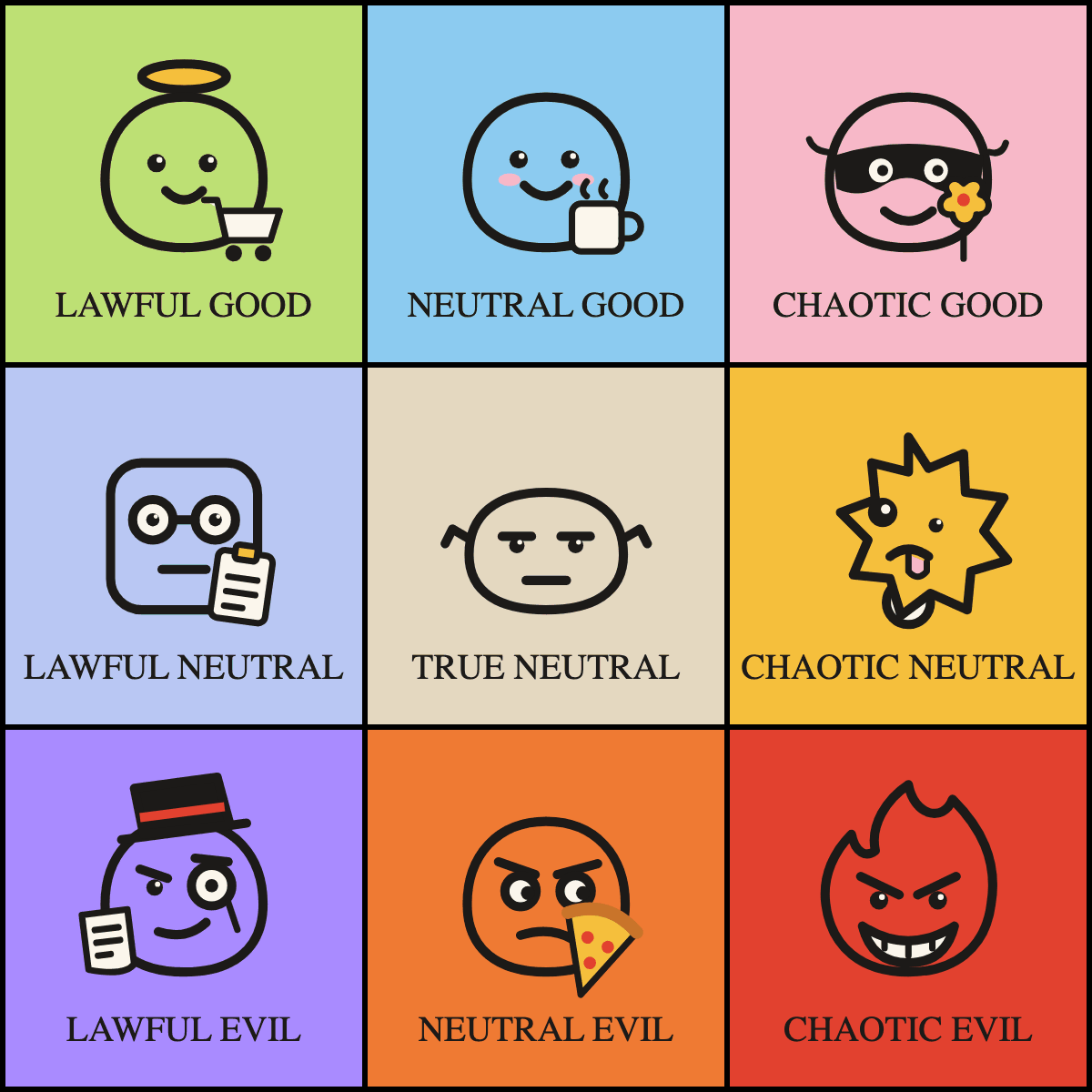 Download this chart
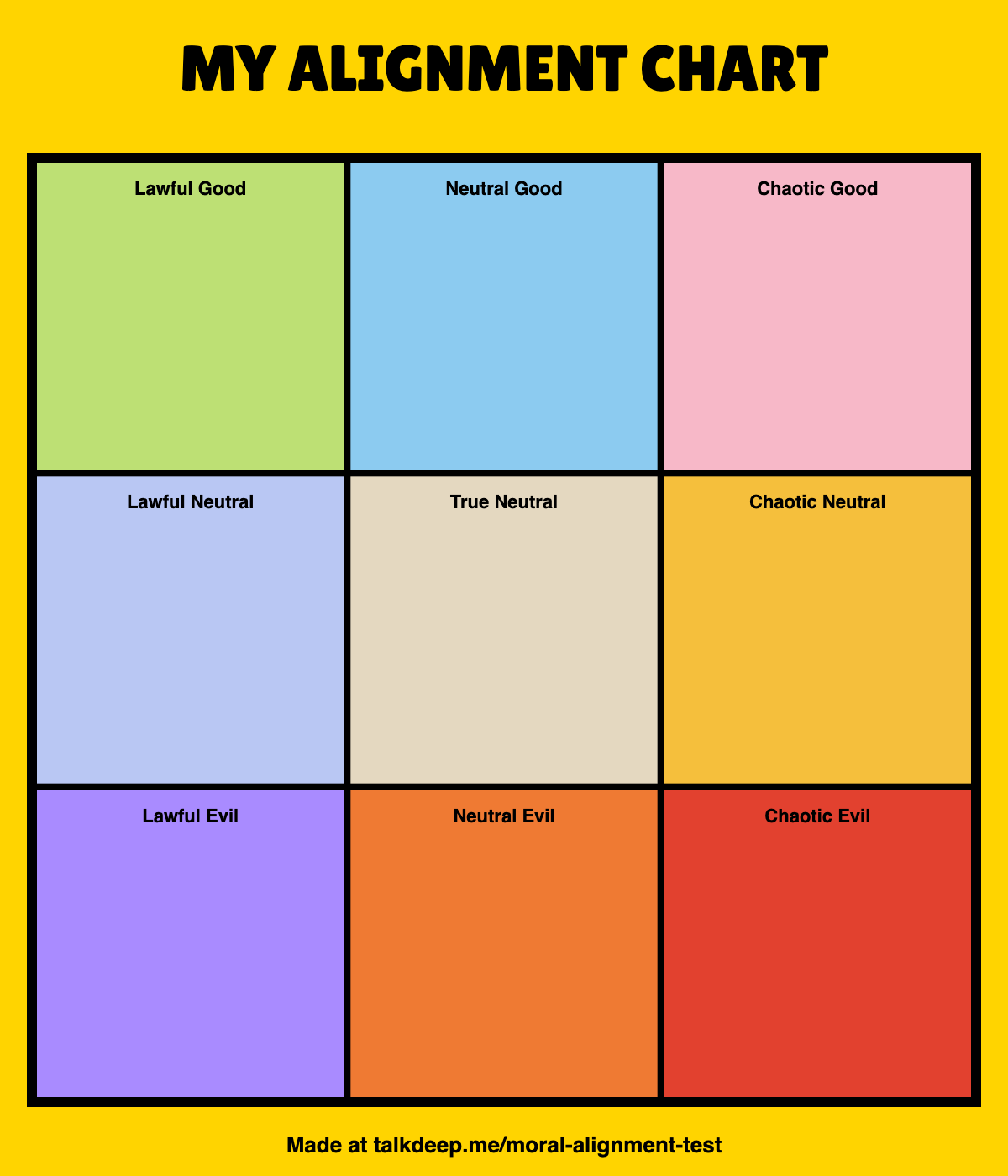 Download a blank chart