Debate topics
179 debate topics for a class, a table or a team meeting, from silly to serious, each argued from both sides, so you never start from nothing. The serious ones have the full case for and against, plus a question to research. No politics and no religion. Or play the game: pick a side, hear the other side’s best line, and hold or cross the floor.
Debate topics to start with
Twelve motions to take to a room right now. Tap one for both sides, or jump to a theme below.
For class
For a big argument
Deal me a debate topic
A random motion with both sides, for a table, a lesson or a team meeting. Pick a theme or take whatever comes.
- This house believes
The middle seat gets both armrests.
ForThe window has the view. The aisle has the legroom. The middle gets the elbows.
AgainstTwo armrests for one person means two people flying with their arms in their laps.
Debate topics for students
The best classroom motions need no research to start, so every student can speak in the first minute. These reward a clear reason over a pile of facts.
- Group projects should be banned.Everyone has a story, and the case against it is better than it first looks.Every exam should be open book.A real policy question. The against side teaches students to look for the catch.Typing matters more than handwriting.Forces both sides to say what handwriting is actually for.Art made by AI shouldn’t count as art.Current, and nobody in the room has an unfair head start.Talent matters more than hard work.Easy to start, hard to finish. Good for practicing examples.
All 12 in this set
Failure teaches more than success.Works as a two-minute speech with one story from each side.Phones should stay out of the lecture hall.Everyone has a phone and an opinion. Ask both sides to define “distraction.”Students should be allowed to use AI on every assignment.The classroom argument of the moment, and students are the experts in it.Memorizing facts is a waste of time now that we can search.Asks what school is for, in one sentence.Participation trophies do more harm than good.Starts light, then turns into a question about what rewards are for.Group study beats studying alone.Practical, and the class can test it the same week.Uniforms make an organization fairer.The classic uniform debate, asked of workplaces and teams as well as classrooms.
Debate topics for high school and college
Older students can handle a motion with a real trade-off in it, where both sides have to give something up. These suit a formal format with a proposition and an opposition, and each has room for research.
- Zoos do more harm than good.Each side has a real ethical case, and evidence to find.If AI writes your book, your name shouldn’t go on the cover.Authorship, credit and honesty in one short sentence.Driverless cars should be the only cars on the road.Safety on one side, responsibility on the other.Social media companies should answer for what’s true on their apps.A good test of who should decide what, and why.Exploring space matters more than exploring the ocean.A clean clash of priorities, with a fact students can check.
All 13 in this set
Old books should never be edited for modern readers.Asks who a book belongs to once its author is gone.Fast fashion does more harm than good.Forces students to weigh a benefit against a hidden cost.Standardized tests should be dropped from college admissions.The fairness of a shared test against the fairness of everything else.Colleges should replace letter grades with written feedback.Students have direct experience, and both sides have hard questions to answer.Animal testing for cosmetics should end everywhere.A real law to examine, and a real limit to the alternatives.AI will take more jobs than it creates.History on one side, “this time is different” on the other.Facial recognition should be banned in public places.Weighs safety against privacy with a very concrete example.Internet access should be treated as a basic right.Teaches the difference between a right and a very useful thing.
Debate topics for adults
For a dinner, a book club or a team away day. Adults argue best about the rules they already live by, and the ones they’ve never said out loud.
- It’s better to be respected than liked.Anyone who has managed people has a strong view on this.Your job should be something you love.Starts as small talk and ends somewhere surprisingly honest.White lies keep friendships alive.Everyone has told one. No two people agree on the limit.A few close friends beat a lot of casual ones.Good late in the evening, when people will admit the real number.A four-day week should be normal.Practical, current, and everyone has done the math.
All 12 in this set
A perfect memory would be a curse.A thought experiment that turns out to be about regret.Working from home beats working in an office.Everyone in the room has lived both sides of this.Privacy matters more than convenience.Ask people to unlock their phones before they answer.A cashless society would be better.Sounds simple until someone asks who gets left behind.Companies should be able to read work email.Awkward for managers, and that’s the fun of it.Tipping should be replaced by better wages.Every country has a rule, and every traveler has a story.AI should write all the boring emails.Everyone’s inbox has an opinion.
Debate topics for ESL and English learners
For language practice, a motion should use everyday words, need no special facts and let a nervous speaker agree or disagree in one sentence. Start with “I think … because …” and let the other side answer.
- Shoes come off at the door, in every house.Everyday words, and every culture has a rule about it.Dessert should come first.Practices “should” and “because” with no vocabulary to look up.You should make your bed every morning.Short daily-life language anyone can use.Phones should go in a basket at dinner.Good for “I agree” and “I disagree, because.”One alarm is all anyone needs.Numbers, routines and mornings: useful words, low stakes.
All 12 in this set
Everyone should learn a second language.A topic every language learner already has an opinion on.Every present should come with a gift receipt.Practices giving and receiving, in words everyone knows.The book is always better than the movie.Comparatives come naturally: better, longer, more exciting.A dog is a better roommate than a person.Simple words, and everyone can picture it.The thermostat should have one owner.Home words, and a clear “should.”Working from home beats working in an office.Work words, and a real choice.Printed textbooks beat tablets for studying.Study words, and a choice everyone has made.
Debate topics for school and college
The classic classroom arguments: homework, phones in class, grades, testing, AI and uniforms. These are written for college and adult classes, so they’re about how learning works, never about children.
Attendance shouldn’t count toward a college grade.
ForA grade should measure what you learned, not where you sat. Some people learn it from the book.
- Students differ in how they learn best.
- Adults paying for their education can decide how to use it.
AgainstHalf of learning is showing up. A class of empty seats is worse for everyone left in the room.
- Discussion only works if people are there.
- Turning up is a habit employers care about.
Go further: What’s the difference between a class you need to attend and one you don’t?
Colleges should replace letter grades with written feedback.
ForA B tells you nothing about what to fix. Two honest sentences tell you exactly.
- Grades encourage chasing marks over understanding.
- Feedback tells you what to do next.
AgainstA grade is the one thing employers and students can compare. Essays about essays can’t be.
- Written feedback takes much more time to do well.
- Without grades, reputation and personal connections may count for more.
Go further: Find a college that doesn’t give grades. How do its graduates get compared?
Phones should stay out of the lecture hall.
ForYou can’t listen and scroll. And the people behind you can’t stop watching your screen.
- Attention is hard to split.
- A shared rule protects the whole room, not just the phone’s owner.
AgainstThese are adults. If a lecture can’t compete with a phone, the problem may be the lecture.
- Phones are also notebooks, dictionaries and cameras for the board.
- Adults should learn to manage distraction, not have it taken away.
Go further: Try a class with and without your phone in reach. What changes?
Homework shouldn’t count toward a college grade.
ForAnyone can get help at home. Only work done under your own name in the room proves anything.
- Help from friends and AI makes homework a poor measure.
- Removing it from the grade lets it be practice again.
AgainstOne big exam rewards a good day. Weekly work rewards the person who kept showing up.
- Regular work spreads learning out, which helps it stick.
- Without a mark, many people will skip it.
Go further: What’s homework for: practice, proof or something else?
Students should be allowed to use AI on every assignment.
ForEvery job they’ll ever have will allow it. Ban it and you’re teaching a world that’s gone.
- Banning it can’t be enforced fairly.
- Learning to check and improve an AI’s work is a skill in itself.
AgainstYou don’t build strength by having a machine lift the weights. Thinking is the point of the work.
- Writing is how many people work out what they think.
- If AI does the first draft, the student may never learn to do one.
Go further: Design an assignment AI can’t complete for you, or one where using it helps you learn.
Standardized tests should be dropped from college admissions.
ForOne Saturday morning shouldn’t outweigh years of work, and practice courses favor those who can pay.
- Test scores can reflect preparation more than ability.
- Other evidence shows what a student did over years.
AgainstGrades mean different things at different schools. A shared test is the only same ruler.
- A shared test can spot talent from schools nobody has heard of.
- Essays and activities can also be coached, sometimes more easily.
Go further: Look up a college that went test-optional. What did it find?
Students should grade their professors in public.
ForProfessors grade you for four years. They can take one honest review from the people in the room.
- Public reviews give teachers a reason to care about teaching.
- New students deserve to know what a class is like.
AgainstPublic scores reward the easy grader and the funny lecturer. The hard, good teacher pays for it.
- Reviews can punish hard courses and reflect bias.
- Fear of ratings can lead to easier grading.
Go further: What would a fair review of a professor actually measure?
Every college student should take a coding class.
ForYou don’t need to be a programmer. You need to know how the machines around you think.
- Code shapes nearly every field.
- One class teaches logic and how to break down a problem.
AgainstEveryone uses electricity and few study wiring. A required class takes time from what you came for.
- AI is changing how much code people need to write.
- One forced class teaches little that lasts.
Go further: Which basic skill would you require of everyone instead, if not this one?
All 24 in this set
Every college degree should include a public speaking class.
ForA great idea you can’t explain goes nowhere, in every job there is.
- Few skills transfer as widely.
- Confidence in front of a room can be taught.
AgainstForcing a terrified student on stage teaches fear. Plenty of fine careers happen in writing.
- Anxiety can make this class a barrier to a degree.
- Clear writing may matter more in many careers.
Go further: Which matters more in the job you want: speaking or writing?
A gap year before college should be the norm.
ForYou pick a degree better after a year of finding out what you can’t stand doing.
- Work or travel can bring maturity and focus.
- It can show you what you don’t want to study.
AgainstMomentum is real. A year off becomes two, and study habits fade faster than you think.
- Not everyone can afford a year without study or income.
- Friends move ahead, and that can be hard to take.
Go further: What would make a gap year useful instead of just a long break?
Studying the arts is as useful as studying science.
ForScience tells you what you can build. The arts are how you work out what’s worth building.
- Arts subjects teach interpretation, judgment and communication.
- Many good products win through design and story.
AgainstA bridge has to stand up. There’s a reason we check the engineer’s math and not the review.
- Science produces results that can be tested and used.
- Some arts degrees have a less direct route to work.
Go further: Find a problem that needed both a scientist and an artist to solve.
Learning history matters more than learning science.
ForMost disasters have happened before, and the warning signs are all written down.
- History teaches you how to weigh evidence about people.
- It’s how a society remembers its mistakes.
AgainstHistory tells you what happened. Science tells you what will, and changes what’s possible.
- Science has a way of correcting itself by experiment.
- Everyday life depends more on science than most people notice.
Go further: Pick one historical event and one scientific discovery. Which changed more lives?
Printed textbooks beat tablets for studying.
ForA page has no notifications. You remember where on the page a thing was, and that helps.
- Paper has fewer distractions.
- Notes in the margin stay where you put them.
AgainstA tablet searches, updates and fits a whole library in one bag. Paper can only sit there.
- Digital text can be searched and read aloud.
- A tablet is lighter than a bag of books.
Go further: Read the same chapter on paper and on a screen. Which do you recall better?
Online degrees are as good as campus degrees.
ForThe material is the same and it reaches people with jobs, families or no college nearby.
- Good online courses let you learn at your own pace.
- Access matters as much as prestige.
AgainstA degree is also the people you meet and the arguments you have in the hallway.
- Labs, studios and hands-on work are hard to move online.
- Finishing alone takes unusual discipline.
Go further: Which subjects move online well, and which don’t?
College should teach life skills before theory.
ForGraduates can explain supply curves and can’t read a lease. That’s the wrong way around.
- People need to handle contracts, work and everyday decisions.
- Practical knowledge is useful right away.
AgainstYou can look up how to read a lease. College is the one place that teaches you how to think.
- Life skills can be picked up from family, friends and search.
- Theory lasts longer than any one practical method.
Go further: Write a list of three things you wish someone had taught you. Could a college teach them?
Professors should be allowed to grade with AI.
ForA tired human on essay ninety isn’t fair either. A machine gives essay one and ninety the same read.
- It could free teachers to spend time with students.
- It’s consistent, and it can return work quickly.
AgainstIf a person wrote it, a person should read it. Feedback from a machine teaches you to write for one.
- AI may not notice an original idea that breaks the pattern.
- Students should know a real reader cared.
Go further: Should students be told when a machine graded their work?
Lectures should be recorded and optional.
ForA recording can be paused, replayed and watched by someone with a job. A lecture can’t.
- Recordings help students who work, care for others or need a second listen.
- They make better use of class time for discussion.
AgainstPeople who can watch it later mostly don’t. A fixed time is the reason the learning happens at all.
- Empty rooms kill the discussion that makes a course good.
- Some people speak less freely if they’re recorded.
Go further: What can only happen in a room together?
Uniforms make an organization fairer.
ForWhen everyone’s dressed the same, clothes stop being a contest of who can afford what.
- A uniform removes a daily decision.
- It gives people a shared identity.
AgainstPeople notice the watch and the shoes instead. All a uniform does is hide who you are.
- Clothes are a form of self-expression.
- A uniform can hide differences without removing them.
Go further: Where do uniforms work best: hospitals, airlines, sports teams? What do those have in common?
Participation trophies do more harm than good.
ForIf everyone gets one, it means nothing, and everyone in the room knows it.
- Real rewards mean more when they’re earned.
- People need to learn how to lose.
AgainstShowing up when you’re not the best is the hard part. That’s worth marking.
- Recognition keeps beginners coming back.
- Rewarding effort can be more useful than rewarding the result.
Go further: What’s the best reward you ever received, and why did it matter?
Memorizing facts is a waste of time now that we can search.
ForYour phone has every date ever. Teach people to judge what they find, not to store it.
- Skills age better than facts.
- Time is limited, and judgment matters more.
AgainstYou can’t question what you don’t already know. Search only helps a mind with something in it.
- Memory is what thinking is built on.
- You can’t spot a wrong answer if you know nothing about the subject.
Go further: Which facts should every adult have in their head with no phone?
Group study beats studying alone.
ForYou never know a subject until you’ve had to explain it to someone who’s confused.
- Explaining a thing tests whether you understand it.
- Others can spot what you’ve missed.
AgainstGroups drift to the pace of the chattiest person. Real understanding happens in a quiet room.
- Groups go off topic easily.
- Some subjects need long, quiet concentration.
Go further: Which part of your studying goes better alone, and which goes better with others?
Every exam should offer a second try.
ForThe point is that you learn it. Why should it matter whether you learned it in May or June?
- One bad day shouldn’t decide a result.
- People learn from their mistakes when they get to fix them.
AgainstReal deadlines don’t come twice. A second try teaches you the first one doesn’t matter.
- It makes grades harder to compare fairly.
- People may prepare less for the first try.
Go further: Which professional exams allow a retake? Why those?
Debate should be a required class in college.
ForFew classes make you argue the side you don’t believe, and every job needs that skill.
- It teaches you to listen, reason and speak under pressure.
- Arguing the other side builds empathy.
AgainstDebate rewards the fastest talker, not the clearest thinker. Not everything should be a contest.
- Some students learn better from writing.
- Debate can reward confidence over accuracy.
Go further: Hold a debate, then swap sides. What changed in your argument?
Apprenticeships are as valuable as college degrees.
ForYou learn from people doing the job, and you start with skills someone already wants.
- Apprentices earn while they learn.
- Practical skills are always needed.
AgainstA trade teaches you one job. A degree should teach you how to move when that job disappears.
- A degree can keep more doors open.
- Some jobs legally require one.
Go further: Compare one trade and one graduate job after ten years. What would you measure?
Serious debate topics: the big questions
Technology and AI, the planet, how we spend our lives and what we owe each other. Each is still a clean yes or no, and each opens to the full case on both sides, with a question to research.
Art made by AI shouldn’t count as art.
ForArt is somebody meaning something. A prompt means you ordered it.
- Art has usually been valued as a record of a person’s intent and effort.
- A model is trained on other people’s work, often without their consent.
AgainstA camera does most of the work too. People said photography wasn’t art either.
- Tools have always changed what art looks like, from the printing press to the synthesizer.
- Judge the work in front of you, not the process behind it.
Go further: Would your answer change if the audience couldn’t tell who, or what, made a piece?
If AI writes your book, your name shouldn’t go on the cover.
ForYou don’t sign a painting because you picked out the frame.
- A byline is a promise about who did the thinking.
- Readers buy a voice, and they’re entitled to know whose it is.
AgainstEditors, ghostwriters and spellcheck all helped too. The idea was still mine.
- Authors have always had help, and only some of it gets credited.
- Choosing, shaping and standing behind the words is authorship.
Go further: How do publishers and writing prizes currently treat AI-assisted books?
Driverless cars should be the only cars on the road.
ForHuman drivers text, tire and get angry. A computer only has to be better than that.
- Software doesn’t get tired, drunk or distracted.
- Cars that talk to each other could cooperate in ways human drivers can’t.
AgainstWhen a driverless car makes a bad call, who do you even get to blame?
- Mixed roads are hard, and rare situations are where machines fail.
- Removing the steering wheel removes a freedom many people value.
Go further: Who should be legally responsible when a driverless car causes a crash?
Zoos do more harm than good.
ForA big enclosure is still a cage, and the animal never asked to be an ambassador.
- Large, roaming animals are hard to keep well in any enclosure.
- Many zoos display animals that aren’t in any breeding or release program.
- A visitor can learn about animals in other ways, including sanctuaries and film.
AgainstStand next to an elephant once and you’ll care about elephants for life.
- Some species have only survived because of captive breeding. The Arabian oryx was hunted out of the wild, then returned from zoo herds.
- Zoos fund field conservation and veterinary research.
- For most people, it’s the only time they’ll stand near a wild animal.
Go further: What separates a good zoo from a bad one, and who checks? Source: The Arabian oryx and captive breeding.
Exploring space matters more than exploring the ocean.
ForThe ocean will be here later. Space is where we go if everything here goes wrong.
- Space exploration has produced satellites we now rely on every day.
- Only space offers a long-term backup for life on Earth.
AgainstWe’ve mapped Mars in finer detail than most of our own sea floor. Start at home.
- We live next to the ocean and depend on it directly, for food, weather and climate.
- Much of the sea floor has never been mapped in fine detail, while Mars has been mapped at higher resolution.
Go further: Which would you fund first, and what would you measure to know it worked? Source: How much of the ocean floor is mapped.
A one-way ticket to Mars is worth taking.
ForEveryone who ever left home for good was told it was crazy.
- Someone has to go first, and the first settlers will shape what comes next.
- A life with a historic purpose may be worth more than a longer ordinary one.
AgainstEverything you love is on this planet. Including air.
- You’d be leaving everyone behind, with no way to change your mind.
- Anyone born there wouldn’t have chosen it.
Go further: What would you need to know before you signed, and who should be allowed to go?
Lab-grown meat should replace farmed meat.
ForIf it’s the same steak and no animal was harmed, what exactly are you defending?
- It could reduce the land, water and animal suffering tied to farming.
- People who love meat wouldn’t have to give anything up.
AgainstFood is more than a product. I want to know a farm was involved.
- Whole farming communities and traditions depend on animals.
- It’s new, and long-term environmental costs are still being worked out.
Go further: How does the energy used to grow meat in a lab compare to raising an animal?
Popular tourist spots should limit visitors.
ForA beautiful place stops being beautiful when you can’t see it for selfie sticks.
- Crowds damage the places they come to see.
- Local residents lose their streets and homes to visitors.
AgainstLimits just mean the view goes to whoever booked first.
- Tourism pays for many local jobs.
- Limits and fees tend to favor people with money and spare time.
Go further: Find a place that has limited visitors. What changed for the people who live there?
All 43 in this set
Social media companies should answer for what’s true on their apps.
ForPrint it in a newspaper and you answer for it. A billion views should be no different.
- Platforms choose what gets amplified, which makes them more than a neutral pipe.
- A false claim can do real damage before anyone corrects it.
AgainstWho do you want deciding what’s true: a company, or you?
- Checking everything at that scale is impossible, so companies would remove too much.
- A company deciding truth for billions is its own danger.
Go further: What’s the difference between a publisher and a platform, and where does a social app sit?
Everyone should take a year off social media once in their life.
ForYou’d find out who your friends are, and who was just a feed.
- A long break shows what you actually miss and what you don’t.
- Attention is easier to reclaim when the habit is broken completely.
AgainstMy friends, my photos and half my town live on there. That’s not a break, it’s exile.
- For many people, it’s how they keep in touch and find work.
- Learning to use it well helps more than a year away from it.
Go further: Try one week off and keep notes. What did you miss, and what didn’t you?
City centers should be free of cars.
ForStreets are the biggest public space we have, and we gave them to parked cars.
- Space for cars can become space for people, shops and trees.
- Streets get quieter and safer.
AgainstTry moving a couch or a week of groceries by bicycle.
- Some people can’t walk or cycle far, and rely on a car.
- Shops depend on deliveries and on customers who drive in.
Go further: Pick a city that has closed streets to cars. Who gained, and who lost out?
Fast fashion does more harm than good.
ForA T-shirt that lasts four washes isn’t cheap. Someone else just paid the difference.
- Clothes bought cheaply are thrown away quickly.
- Low prices often depend on low pay somewhere down the chain.
AgainstIt lets people dress well without a big budget. That used to be impossible.
- Affordable clothes matter most to people on small budgets.
- The industry provides jobs in the countries that make the clothes.
Go further: Trace one T-shirt: who made it, from what, and where does it go after you?
Recycling is mostly about making us feel better.
ForBuying less beats sorting more. The blue bin is a very clean way to feel finished.
- Sorting your trash can feel like enough, so bigger habits never change.
- Not everything put in a bin actually gets recycled.
AgainstSmall habits are how big ones start. Giving up is easier, not smarter.
- Recycling keeps materials in use and out of landfill.
- Shared habits build support for bigger change.
Go further: What actually happens to the recycling collected in your town?
Bringing back extinct animals is a bad idea.
ForThe habitat is gone. Time spent reviving one mammoth is time not spent saving what’s alive.
- A revived animal has no family, no habitat and no idea how to live.
- It may make people care less about extinction, if it looks reversible.
AgainstIf we wiped them out, maybe we owe them a second chance.
- Some lost animals played roles in their ecosystems that haven’t been replaced.
- The research could help species that are still alive.
Go further: Which extinct animal would make the strongest case, and where would it live?
Being a good listener matters more than being a good speaker.
ForEvery room has plenty of talkers. The person people trust is the one who heard them.
- People open up to someone who hears them, and that’s how trust gets built.
- You can’t answer what you didn’t hear.
AgainstGreat ideas die in quiet heads. If you can’t say it, it didn’t happen.
- Listening alone changes nothing. Someone has to make the case.
- People who speak well get heard, and so do the causes they speak for.
Go further: Think of the person who most changed your mind. Did they talk or listen?
Talent matters more than hard work.
ForYou can’t practice your way to seven feet tall, and you can’t coach an ear.
- Two people can train equally hard and end up in very different places.
- Early ability gets attention, coaching and confidence, which compound.
AgainstTalent that never shows up loses to average that shows up every day.
- Talent is only a head start. Most fields reward years of steady work.
- Believing in talent gives people a reason to quit early.
Go further: Pick someone at the top of their field. What did they have, and what did they do?
Failure teaches more than success.
ForYou’ll remember the day it went wrong for the rest of your life.
- Failure forces you to look at what you did.
- It shows you which of your assumptions were wrong.
AgainstFailure mostly teaches you to be scared. Winning shows you what works.
- People can fail repeatedly and learn nothing.
- Success shows you a method you can repeat.
Go further: Tell a failure and a success. Which one changed what you do now?
It’s better to be respected than liked.
ForBeing liked lasts until you say no. Respect survives the no.
- Being respected lets you say hard things and still be heard.
- People chasing approval tend to avoid decisions.
AgainstPeople will work hard for someone they like. For respect, they’ll just be careful.
- People give more to someone they like, and tell them the truth.
- Respect without warmth can slide into fear.
Go further: Think of the best boss or teacher you’ve had. Which did they earn first?
A perfect memory would be a curse.
ForYou’d never forget a fight, a bad haircut or that thing you said at the wedding.
- Forgetting helps people heal and forgive.
- A mind that keeps everything has less room to notice what matters.
AgainstYou’d never lose your favorite day. Every laugh, every voice, exactly as it was.
- You’d keep every lesson, name and kindness.
- Many of our arguments and mistakes come from remembering things wrongly.
Go further: Is forgiving possible if you can’t forget?
Living forever would be a bad deal.
ForNothing feels urgent if you have forever. Endings are what make days count.
- Everyone you love might not choose it with you.
- A world where no one leaves has a problem with room and change.
AgainstPeople who say that have plenty of time left. Ask again when you run out.
- Most people, on most days, want tomorrow.
- Great work takes more than one lifetime.
Go further: Would you still want it if you were the only one?
Knowing your future would make life worse.
ForEvery surprise, gone. You’d sit through your own life like a rerun.
- Hope depends on not knowing.
- You’d start grieving things long before they happened.
AgainstI’d take a few spoilers to skip the worst mistakes.
- You could prepare and say what needs to be said.
- Knowing a hard thing is sometimes kinder than being surprised by it.
Go further: Is there one fact about your future you’d want to know? Why that one?
A few close friends beat a lot of casual ones.
ForWho’s helping you move at six in the morning? That’s the real number.
- Close friendships take time, and time is limited.
- A few people who know you beat a crowd who know of you.
AgainstEvery job, trip and great party I’ve had came from someone I barely knew.
- Loose contacts bring new ideas and opportunities.
- Different friends meet different needs.
Go further: List who you could call at 3 a.m., then who introduced you to your last job or hobby.
Your job should be something you love.
ForYou’ll spend a third of your life there. A third is too much to waste.
- Work you care about is easier to do well.
- Spending your days on something that means nothing has a cost.
AgainstTurn your favorite thing into a job and see how long it stays your favorite.
- Plenty of people live full lives around a job that’s just a job.
- Not everyone has the luxury of choosing.
Go further: If your job paid the same whatever you did, what would you do?
Old books should never be edited for modern readers.
ForIf you don’t like what a dead author wrote, write your own book.
- Old books are a record of their time, and changing them hides it.
- If the words offend, add a note. Don’t rewrite the author.
AgainstEditors have always updated books. A footnote isn’t a bonfire.
- Books have long been revised between editions.
- A new reader may never get through a page that hurts them.
Go further: Find a book that’s been changed. Did the change alter the meaning?
Every sport should use video review.
ForEveryone at home can see it was out. The one person who can’t shouldn’t decide.
- Fans can already see the replay, and a wrong call decides seasons.
- Fairness is the reason sports have rules.
AgainstSports are about the moment. You can’t celebrate while someone watches a monitor.
- Stopping play breaks the flow and the joy of the moment.
- Slow-motion replays can make a normal contact look worse than it was.
Go further: Pick a sport with video review. Has it reduced arguments, or moved them?
Esports are real sports.
ForPacked arenas, years of training, and a final that breaks hearts.
- It takes skill, reflexes, teamwork and practice.
- Many accepted sports involve little physical exertion.
AgainstA sport tests the body as well as the mind. Chess has packed halls and years of training too.
- Sports are usually defined by physical skill.
- A game owned by a company can be changed or switched off.
Go further: Write a definition of “sport” that includes everything you want it to and nothing else.
Everyone should learn a second language.
ForYou don’t really know your own language until you’ve struggled in another.
- Another language opens another way of seeing things.
- It’s also a sign of respect wherever you travel.
AgainstMy phone translates anything now. I’d rather learn to cook.
- Years of study could go to something a person will really use.
- Translation tools are getting better every year.
Go further: What can’t a translation app do in a real conversation?
Animal testing for cosmetics should end everywhere.
ForA new shade of lipstick isn’t worth an animal’s suffering. There are plenty of shades already.
- Plenty of ingredients are already known to be safe, so new ones aren’t essential.
- The EU has banned the sale of cosmetics tested on animals since 2013, and its market kept working.
AgainstA global ban only moves the question. Someone still has to prove new ingredients are safe, somehow.
- Alternatives can’t yet replace every test.
- Some ingredients also have other uses that may still require testing by law.
Go further: What are the alternatives to animal tests, and what can’t they do yet? Source: The EU ban on animal testing for cosmetics.
Social media does more harm than good.
ForIt’s built to keep you scrolling, not to leave you better off. The product is your attention.
- Outrage spreads faster than care.
- It replaces time we’d spend with people in person.
AgainstIt lets people find their community, wherever they live. Before it, many simply went without.
- It has helped movements, small businesses and families stay connected.
- How it’s used may matter more than the app.
Go further: List what you got from your feed this week. Was it worth the time?
AI will take more jobs than it creates.
ForThis time the machine does thinking as well as lifting. What’s left to move on to?
- AI can do many tasks at once, across many fields.
- Those who lose work may not be those who get the new jobs.
AgainstEvery big technology has been predicted to end work. Each time, new kinds of work appeared.
- New tools often create jobs that nobody predicted.
- Lower costs can create demand for more work.
Go further: Pick your dream job. Which parts could AI do, and which couldn’t it?
Facial recognition should be banned in public places.
ForYou can change your password. You can’t change your face, and you never agreed to be logged.
- People behave differently when they’re watched.
- Errors can land on innocent people.
AgainstIf it finds a missing person, it’s doing what we’d ask a thousand people to do by hand.
- It can help find missing people and solve serious crimes.
- With strict rules, it needn’t be misused.
Go further: What rules would make you comfortable, if any?
People should have to use their real names online.
ForPeople say things under a fake name they wouldn’t say to a face. A name brings a cost back.
- Accountability improves how people behave.
- It makes fake accounts harder to run.
AgainstPlenty of people need a mask to speak at all. Real names silence them, not the bullies.
- Anonymity protects people who are at risk.
- Real names don’t stop people from being cruel.
Go further: Who has the most to lose if real names were required?
Internet access should be treated as a basic right.
ForJobs, banks and forms have all moved online. No access now means no way in.
- Services, work and study are moving online.
- People without access fall further behind.
AgainstCalling everything a right weakens the word. It’s a useful service, like a phone line.
- Rights should be kept for what’s essential to life.
- Someone has to pay for it, and that’s a real trade-off.
Go further: What’s the difference between a right and a very useful service?
Privacy matters more than convenience.
ForYou give away a little each tap, and you can never take any of it back.
- Data, once given, can’t be recalled.
- What seems harmless now may not be later.
AgainstMost people happily trade data for a map that works. That’s a real choice, not a mistake.
- Free services are built on that trade.
- Personal data can make products genuinely better.
Go further: Check the permissions on three apps. Which would you turn off?
Working from home beats working in an office.
ForNo commute, fewer interruptions and your own kitchen. Good work doesn’t need a lanyard.
- Time saved on travel goes to work or family.
- Many people focus better at home.
AgainstJunior people learn by overhearing. You can’t pick up how a job is done through a screen.
- Trust and creativity often grow in person.
- Not everyone has a good place to work at home.
Go further: Which parts of your work need a room with other people in it?
Single-use plastics should be banned.
ForWe make something that lasts for centuries so it can be used for four minutes.
- Much of it ends up in nature.
- Reusable alternatives exist for many everyday things.
AgainstThe replacements can cost more to make and carry. A ban feels good; the sums may not.
- Some disabled people rely on single-use items such as straws.
- Some food packaging reduces waste by keeping food fresh longer.
Go further: Pick one plastic item you use daily. What would replace it, and at what cost?
A cashless society would be better.
ForFaster, harder to steal and no more digging for coins while a line builds behind you.
- Digital payments are easy to track and quick to use.
- Less cash means less to steal.
AgainstCash works without a bank, a battery or a record of every coffee you’ve ever bought.
- Some people don’t have bank accounts or smartphones.
- Systems go down, and cash still works.
Go further: Who would be left out of a cashless shop, and how could they be included?
Daylight saving time should end.
ForTwice a year everyone moves every clock to save nothing we can clearly name.
- Changing the clocks twice a year disrupts schedules.
- Most people can’t explain why we still do it.
AgainstAn extra hour of evening light in summer is one of the few free things a society can hand out.
- Lighter evenings suit shops, sports and leisure.
- Some places would get very dark mornings under a permanent time.
Go further: Which would you keep: lighter mornings or lighter evenings?
Wild animals shouldn’t perform in circuses.
ForA life on a truck learning tricks isn’t what a tiger is for.
- Travel and training restrict animals’ natural lives.
- A show can be as thrilling with human performers.
AgainstIf the animals are well treated, the crowd falls for them. People protect what they’ve seen.
- Good handlers care for and bond with their animals.
- Live contact can inspire care for wildlife.
Go further: Where is the line between working animals and performing ones?
Video games are a form of art.
ForWriting, music, acting and design, and you’re inside it. What’s missing?
- Games can move people as books and films do.
- The player’s choices are part of the meaning.
AgainstArt says something to you. A game needs you to win, and that changes what it can say.
- Many games are products built around rewards and repetition.
- A game with no author’s fixed view is hard to read as a statement.
Go further: Name one game you’d put in a museum, and explain why.
Professional athletes are paid too much.
ForA nurse saves lives and a striker scores goals. Pay has come loose from what matters.
- Pay is far above most jobs that society depends on.
- Careers in many sports pay almost nothing outside the top level.
AgainstThey fill stadiums and the money’s going somewhere. Better them than the owners.
- Careers are short and risky.
- People choose to pay to watch.
Go further: Should pay reflect value to society, or what the market will pay?
Space tourism should wait until Earth’s problems are solved.
ForA joyride above the clouds is a strange use of a burning planet’s fuel.
- Resources are limited, and it’s an elite activity.
- Rocket launches have an environmental cost.
AgainstEarth’s problems will never be finished. Early flights paid for the planes we all use now.
- Commercial flights often pay for research.
- Seeing Earth from above may change how people think about it.
Go further: Is there a rule for what’s worth doing before all problems are solved?
Libraries matter more now than they ever did.
ForIt’s one of the last indoor places where you can stay all day without buying anything.
- They offer free space, help and internet to all.
- A librarian helps you judge what’s reliable.
AgainstEvery book is a search away now. Love the building, but the job has moved.
- Much of the material is online.
- Scarce public funds have other urgent uses.
Go further: Visit a library and count what people are doing there. How many are reading?
Debate topics about technology
Small fights about the things in our pockets and on our screens.
Autocorrect does more harm than good.
ForIt has ducking ruined more messages than it ever saved.
AgainstYou haven’t seen what your thumbs actually type.
Robots should do all the chores before they do any art.
ForWe wanted a robot to do the ironing so we could paint. Not the other way around.
AgainstFolding a shirt turns out to be harder than a painting. Take the help you get.
AI should write all the boring emails.
ForThey were never really read anyway. Let the robots talk to each other.
AgainstThen both ends are robots, and we’ve invented a very slow way of saying nothing.
Headphones in public mean do not disturb.
ForThey’re the only door you can close on a train.
AgainstHeadphones block sound, not people. You’re still in a shared space, and manners still apply.
Emoji count as a real language.
ForOne small thumbs-up can end a conversation colder than any word.
AgainstTry asking the way to the station with a sad cat.
Every group chat needs a leader.
ForOtherwise the plan stays at “yeah we should” for six months.
AgainstGive someone power in a group chat and you’ll get a poll about the poll.
Read receipts should always be on.
ForIf you’ve read it, you’ve read it. Honesty is one small tick.
AgainstA tick doesn’t mean I’ve read it. It means I owe you a reply by dinner.
New series should come out one episode a week.
ForA week of guessing is half the show. You can’t argue about a finale you binged alone.
AgainstI pay to watch, so I pick the pace. A story shouldn’t need a week’s wait to feel important.
All 18 in this set
A smart fridge solves a problem that doesn’t exist.
ForThe fridge already had one job: cold.
AgainstYou’ve stood in the store wondering if you’ve got eggs. That’s the problem.
Phones should go in a basket at dinner.
ForYou came all this way to look at someone else’s vacation?
AgainstAnd who’s going to settle what year that movie came out?
Calling someone without texting first is rude.
ForAn unplanned call is someone walking into your kitchen.
AgainstIt takes one minute. You’ve spent forty texting about it.
Phones should be banned at concerts.
ForYou went all that way to watch the stage on a very small screen.
AgainstThat shaky video is the only reason you’ll remember song four.
The book is always better than the movie.
ForA movie gets two hours. A book gets all the room in your head.
AgainstA movie has a score, a face and a car chase. A page has to do all that alone.
Every movie is ten minutes too long.
ForName one movie that needed that extra scene in the car.
AgainstThe scene you’d cut is someone’s favorite. A story that rushes never gets to breathe.
You shouldn’t film strangers for the internet without asking.
ForYour bad day isn’t my content, and mine isn’t yours.
AgainstIf you do something wild in public, the public gets to see it.
You should be able to unsend any message for a full day.
ForEveryone gets one bad idea at 1 a.m. It doesn’t have to be permanent.
AgainstIf you can take back anything, nothing anyone says means anything.
Influencers should have to label every ad.
ForIf you’re paid to love it, say so. The whole sale works because it looks like a friend’s advice.
AgainstViewers aren’t fools. Everyone knows a sponsored smile, and a label won’t stop anyone buying.
An AI should always have to say it’s an AI.
ForYou have a right to know who you’re talking to, especially if it’s trying to persuade you.
AgainstIf the answer is right, who cares? We don’t ask a calculator to introduce itself.
Debate topics about work
Everyone has sat in a meeting, so everyone has a view. They work well in workshops and team away days.
Group projects should be banned.
ForFour names on the slide. One person did it. Everybody knows.
- Shared grades reward the people who do the least and punish the people who care most.
- Good collaboration can be taught on purpose, in pairs with clear roles, without one mark for four people.
AgainstEvery job is a group project. Better to meet the one who does nothing early.
- Most real work is done with people you didn’t choose.
- Learning to split a task, chase a colleague and settle a disagreement is the point of the exercise.
Go further: How could a group project show who did what without turning into surveillance?
Every exam should be open book.
ForAt work, you’re allowed to look it up. Why train for a world that doesn’t exist?
- Open-book exams test understanding, since nothing can simply be copied into the answer.
- They reduce last-minute memorizing that fades within a week.
AgainstIf the book is open, the questions get harder. Careful what you wish for.
- Some knowledge has to be in your head before you can think with it.
- Students who rely on the book run out of time.
Go further: Which subjects lose the most from an open-book exam, and which lose nothing?
Typing matters more than handwriting.
ForThe last thing anyone read in your handwriting was a birthday card.
AgainstPeople keep handwritten notes for years. You’ll never frame an email.
A four-day week should be normal.
ForYour best work doesn’t happen at four on a Friday.
AgainstCustomers don’t stop on Fridays. Squeeze five days of work into four and every day gets worse.
Cameras should be optional on video calls.
ForSeeing my bookcase has never once helped anyone listen.
AgainstPresenting to nine black squares is how you lose the will to present.
Open-plan offices should be left in the past.
ForIf you can hear someone’s lunch, you’re not at work. You’re at their lunch.
AgainstWalls are how you go three years without learning who sits next door.
Office birthday cake should be mandatory.
ForIt’s the only meeting anyone has ever wanted to go to.
AgainstNothing kills a party like a calendar invite with the word “fun” in it.
A long lunch beats leaving early.
ForIt cuts the day in two. Two short halves beat one long afternoon.
AgainstAn hour at the end of the day is yours. The long lunch is still at work.
All 17 in this set
Work chats should go quiet at six.
ForIf it can’t wait until morning, it’s a phone call. If it isn’t a phone call, it can wait.
AgainstSome of us do our best thinking at nine at night, and we’d like to say so.
Reply-all should need a second person’s approval.
ForTwo hundred people did not need to see your “thanks!”
AgainstReply-all is how a whole team spots the mistake. Add an approval step and the fix arrives too late.
Meetings should be held standing up.
ForNothing shortens a meeting like sore feet.
AgainstAll you’ve done is make the long meeting tiring as well.
Whoever calls a meeting brings the donuts.
ForThere would be half as many meetings by next week.
AgainstThere’d be just as many, and they’d all be at ten past one, after lunch.
Icebreakers should be illegal.
ForYour best self has never come out during two truths and a lie on a Monday.
AgainstThe alternative is an hour of silence with twelve strangers. Your call.
No email should be longer than three sentences.
ForIf you need a fourth sentence, you need a phone call.
AgainstCut it to three sentences and you’ll get five emails asking what you meant.
Every boss should have to do your job for a day each year.
ForOne morning with that printer and “it’s a simple request” would disappear forever.
AgainstOne day won’t teach the job. It teaches a boss they know the job, and that’s more dangerous.
A meeting without an agenda should be canceled.
ForIf you can’t say what it’s for, it’s a hostage situation with coffee.
AgainstThe best idea you ever heard at work came from a meeting that wandered.
Companies should be able to read work email.
ForIt’s their system, their name on it and their risk if something goes wrong.
AgainstYou can trust someone or you can read their mail. A workplace that reads everything gets neither.
Fun debate topics
Pure nonsense, argued with total commitment. These are the best ones to start with, because nobody’s pride is on the line, and that’s exactly when people argue hardest.
A dragon would make a better pet than a unicorn.
ForA dragon guards your house, heats it and gets you to work. A unicorn offers a nice mane.
AgainstA pet you can’t feed, house or keep indoors isn’t a pet. A unicorn you can actually live with.
Traveling to the past beats traveling to the future.
ForThe past has dinosaurs, lost music and every argument you wish you’d won.
AgainstThe past has no plumbing and no idea who you are. The future has answers.
Pirates would beat ninjas.
ForPirates have cannons, a ship and a crew that’s already angry.
AgainstA ninja wins before the pirate knows there was a fight.
Robots would run a better restaurant than people.
ForA robot never forgets the sauce and never asks how it is while you’re chewing.
AgainstA robot can bring your food. It can’t see it’s your birthday or that you’re having a bad night.
In a zombie movie, the smart move is to stay put.
ForEvery disaster in those movies starts with someone saying “let’s split up.”
AgainstStaying put is how you end up in a basement in the last ten minutes, out of cans.
Aliens have already visited, and they weren’t impressed.
ForIt explains the silence. You don’t text back after a first date like that.
AgainstEvery traveler in history has left a trace. Crossing a galaxy and leaving none is the harder story.
A hero with gadgets beats a hero with powers.
ForGadgets can be fixed, upgraded and lent to a friend. Powers just happen to you.
AgainstGadgets run out of battery. Flying doesn’t need a charger.
A haunted house is a fair price for an ocean view.
ForGhosts are quiet, they keep to the attic and they’ll never borrow your ladder.
AgainstA view is for relaxing. You can’t relax in a house where something upstairs knows your name.
All 22 in this set
Second breakfast should be a recognized meal.
ForEleven o’clock already has the hunger. All it needs is a name.
AgainstGive it a name and someone will book you a second-breakfast meeting.
Mermaids have it better than centaurs.
ForA mermaid has a whole ocean. A centaur has to find a very wide door.
AgainstA centaur can go to a party. A mermaid has to be carried in a bathtub.
One horse-sized duck would be easier to fight than a hundred duck-sized horses.
ForOne enemy, one direction. A hundred tiny horses is a hundred tiny problems.
AgainstThat duck is as tall as a horse and it has a beak. Tiny horses you can step over.
A hundred people would beat one gorilla.
ForIt can only hold on to about four of you. The other ninety-six are free.
AgainstSomebody has to go first. In a crowd of a hundred, you’ll all wait for somebody.
Life would be better with a soundtrack.
ForA walk to the trash cans would become a scene. You’d stand up straighter.
AgainstEveryone in the room would hear the sad piano start when you check your phone.
Invisibility beats flying.
ForFlying gets you somewhere. Invisibility gets you the truth.
AgainstInvisibility only works when you sneak. Flying is the one power you’d use in front of everyone.
The villain usually has a point.
ForThe villain is the only one in the movie with a plan, a staff and a five-year vision.
AgainstA good point stops being one when your plan needs a shark tank. How you win is the point.
Vampires have it worse than werewolves.
ForNo sunrise, no garlic bread, and everyone you know gets old without you.
AgainstA vampire chooses to bite. A werewolf loses control once a month and wakes up not knowing why.
Talking to animals beats speaking every language.
ForYou already know what people think. Imagine knowing what the pigeons are planning.
AgainstYour cat would only use it to complain. Every language gets you fed anywhere on Earth.
Pausing time beats rewinding it.
ForPause means a nap in the middle of every meeting you’ll ever have.
AgainstRewind means you never say that thing at the wedding.
If dogs could talk, we’d like them less.
ForRight now he adores you. One sentence and you’d learn he’s been judging your singing.
AgainstYou’d finally know where it hurts, what scares him and why he barks at that one fence.
The sidekick deserves half the credit.
ForSomeone drove the van, did the research and took the second punch.
AgainstAnyone can hold the flashlight. Only one of them walked in first.
Three wishes would ruin your life.
ForEvery story with a genie ends with someone wishing it had never started.
AgainstThose people wished carelessly. You’ve been planning this for years.
A time machine should require a license.
ForYou need a test to drive to the store. This thing can delete your grandfather.
AgainstThe person who’d wait in line for that license isn’t who should be saving history.
Debate topics about food
Everyone eats, so everyone is an expert. These aren’t about what tastes best: they’re about the rules of the table, like who pays, who cleans up and who gets the last slice.
Whoever cooks should never do the dishes.
ForYou’ve done the hard part. You don’t ask the painter to sweep the gallery.
AgainstFree dishes is how one bowl of pasta ends up using every pan in the house.
Taking the last slice without asking is theft.
ForEveryone was looking at it. That polite silence was a contract.
AgainstIt’s been sitting there for forty minutes. Hesitation has a price.
Splitting the check evenly is fair, whatever you ordered.
ForFriends don’t bring calculators to dinner. It evens out over a lifetime.
AgainstI had a side salad. You had the lobster and three opinions about wine.
Soup is not a meal.
ForIf you can finish it with a straw, it’s a drink with ambitions.
AgainstIt has a bowl, a spoon and bread. That’s more meal than a sandwich.
If you ask for a bite, you owe a bite.
ForA taste is a loan. I’d like to see some of your fries now.
AgainstKeeping score over a fry turns a friendly dinner into a ledger. Friends share without invoices.
Sharing plates ruin a good meal.
ForI chose this, I want all of it, and I don’t want your fork anywhere near it.
AgainstOrder one dish and one wrong choice ruins dinner. Order four and the table can’t lose.
Whoever picks the restaurant can’t complain about it.
ForYou had the whole internet and you brought us here. Eat your choice.
AgainstPicking the place doesn’t mean I run the kitchen. This soup is still cold.
Double-dipping at a party is a crime.
ForThat chip has been in your mouth. The dip did not agree to this.
AgainstYou’ve shared drinks with these people. A chip is where you draw the line?
All 16 in this set
Ketchup belongs in the fridge.
ForRead the bottle. “Refrigerate after opening” isn’t a suggestion.
AgainstDiners leave it on the table all day and nothing happens. It’s vinegar, sugar and salt.
Dessert should come first.
ForYou only say you’re full because they always serve it last.
AgainstDessert is the reward. Eat it first and what did you do to deserve it?
It can’t be your signature dish if it comes from a box.
ForYou added water. The box did the rest and it deserves the credit.
AgainstI chose the box, I added the secret ingredient, and you came back for seconds.
Brunch is a scam.
ForIt’s breakfast, late, with a line, and you’ve been hungry since nine.
AgainstIt’s the only meal where cake and eggs can share a table without a word said.
Spicy food is mostly showing off.
ForCrying into a curry isn’t flavor. It’s a performance.
AgainstHeat is a flavor you learn, like coffee or olives. Whole cuisines aren’t built on showing off.
Tip screens at the counter have gone too far.
ForYou handed me a muffin. That screen wants me to reward a handoff.
AgainstOne tap is a small kindness to someone on their feet all day.
A potluck guest who brings store-bought should confess.
ForThat’s a grocery store pie in your grandmother’s dish, and we all know it.
AgainstYou wanted a pie and you got a pie. This isn’t a courtroom.
Tipping should be replaced by better wages.
ForA person’s rent shouldn’t depend on the mood of table six.
AgainstA tip is how you say thanks directly, and it’s why good service still gets noticed.
Debate topics about everyday life
The ones already going on in your kitchen. Good for families, roommates and anyone who has ever reloaded a dishwasher in silence.
The front seat belongs to the tallest, not the fastest.
ForLegs are a fact. Calling shotgun is just being loud near a car.
AgainstCalling it is the only fair system we have. You could have said it first.
A dog is a better roommate than a person.
ForA dog will never eat your labeled cheese or leave one square of toilet paper.
AgainstA dog also won’t take itself out at six in the morning.
A vacation should be planned hour by hour.
ForYou get seven days somewhere new. “See what happens” means a sandwich in a parking lot.
AgainstThe best vacation story ever told didn’t start with “at 2:15, as scheduled.”
One alarm is all anyone needs.
ForSet five alarms and you’ve taught yourself that four of them don’t count.
AgainstThe first alarm isn’t there to wake you. It opens the negotiations.
Only one person in a home should load the dishwasher.
ForThere’s a right way, and everyone who has seen a bowl face the wall knows who it isn’t.
AgainstName one expert and you’ve just found who does that chore for the rest of their life.
A seating plan makes every dinner better.
ForWithout one, couples sit together and the two funny people end up miles apart.
AgainstGuests relax when they choose. Put a card on a chair and dinner starts to feel like a test.
The thermostat should have one owner.
ForA democracy of the thermostat is a war fought one degree at a time.
AgainstOne owner means everyone else wears a coat on the couch.
Self-checkouts should go.
ForThey turned every shopper into an unpaid cashier, and the job still needs a person to fix it.
AgainstFive items, no line, no small talk. Everyone who uses them is choosing them.
All 21 in this set
Rules should be read before the game starts.
ForOtherwise one person “remembers” a rule exactly when it helps them.
AgainstForty minutes of someone reading a booklet aloud has ended more game nights than cheating.
Every present should come with a gift receipt.
ForIt says: I tried, and I know I might be wrong.
AgainstIt says: I expect you to hate this.
You should make your bed every morning.
ForIt takes a minute, and it may be the only thing today that goes exactly right.
AgainstYou’re getting back in it tonight. It’s the one chore that undoes itself on schedule.
Shoes come off at the door, in every house.
ForYou’ve walked through a public restroom in those.
AgainstYou don’t dress up for a dinner party to stand around in mismatched socks.
Morning people should keep it to themselves.
ForBeing cheerful at someone who’s still waking up isn’t kindness. It’s noise with a smile on it.
AgainstNight owls never get told to hide. If a good mood annoys you, the problem isn’t the mood.
Soaking a pan overnight counts as washing it.
ForBurned-on food needs water and time. A night of soaking does what an hour of scrubbing can’t.
AgainstA pan in dirty water isn’t clean. It’s a wet promise, and someone else has to finish it.
The chair with clothes on it is a closet.
ForThere’s a system. I know exactly which layer that sweater is in.
AgainstIf there were a system, you wouldn’t be smelling the sweater.
If you borrow a car, you return it with a full tank.
ForYou got a free car for a day. The least you can do is buy it a drink.
AgainstI’ll return it exactly how I got it. That’s what “borrow” means.
Whoever finishes the milk buys the milk.
ForYou saw it was empty and put the carton back in the fridge. We all know.
AgainstI had the last sip. You had the other nine tenths. Let’s talk.
Your roommate can eat your food if it’s about to expire.
ForThat yogurt had hours to live. I gave it a purpose.
AgainstYou don’t get to eat my things and call it a rescue mission.
Neighbors should ask before getting a drum kit.
ForYour hobby stops at my bedroom wall at seven on a Saturday.
AgainstYou moved next to a world with noise in it. Buy earplugs.
You must wave thanks when someone lets you merge.
ForOne hand, one second. It’s the last bit of manners left on the road.
AgainstThey let me in because the lane ended, not because they’re a saint.
Saving a pool chair with a towel shouldn’t count.
ForIf you’re asleep upstairs, you are not using the pool chair.
AgainstI got up at seven for this towel. That’s called planning.
Debate topics about friends and manners
The unwritten rules, written down. Nearly everyone thinks their version is the obvious one, which is what makes these so good.
The middle seat gets both armrests.
ForThe window has the view. The aisle has the legroom. The middle gets the elbows.
AgainstTwo armrests for one person means two people flying with their arms in their laps.
It’s fine to recline your seat on a plane.
ForThe button is on the seat. The seat is mine. The button is part of the seat.
AgainstYour comfort is now my knees’ problem for the next five hours.
Arriving early is as rude as arriving late.
ForI’m still in a towel. You’ve turned my last ten minutes into your problem.
AgainstAsk anyone waiting alone at a restaurant if they wish their friend were later.
Voice messages should have a one-minute limit.
ForIf it takes four minutes, it’s a phone call you’ve forced me to attend alone.
AgainstSome stories need the pauses. You can’t type that impression.
Saying “we should catch up” without a date is lying.
ForIf you meant it, there’d be a date.
AgainstIt means “I like you and I’m tired.” Everyone knows what it means.
Spoilers stop counting after a year.
ForYou’ve had a whole year. At some point that’s on you.
AgainstSomeone is always watching it for the first time. It costs you nothing to keep quiet.
“I don’t mind” is the worst answer to “where should we eat?”
ForYou do mind. You’ll prove it by turning down the third suggestion.
AgainstIt’s a gift. You get to choose, and I get to be surprised.
Sidewalks need a fast lane.
ForEveryone has been stuck behind four friends walking in a slow, wide wall.
AgainstIt’s a walk, not a freeway. Go around.
All 18 in this set
Surprise parties are a bad idea.
ForYou want to be ambushed in your work clothes by everyone you know?
AgainstA dozen people kept a secret just to make you happy. Name a nicer thing.
You can leave a party without saying goodbye.
ForThe goodbye takes forty minutes and you’ve already said everything. Just go.
AgainstThirty seconds of “see you” beats a week of “when did you leave?”
It’s better to be the funniest person in the room than the smartest.
ForSmart people get asked for help. Funny people get asked to stay.
AgainstBeing funny fills the silence. Being smart means you know when to leave it.
White lies keep friendships alive.
For“I love it” has saved more friendships than honesty ever has.
AgainstIf I can’t trust your “I love it,” what’s it worth?
Everyone should have to work in a restaurant once.
ForYou would never snap your fingers at a waiter again.
AgainstServing is a skilled job, not a lesson for the rest of us, and real customers pay for your practice.
Bad karaoke beats good karaoke.
ForThe loudest cheer in the room goes to someone losing to the high note.
AgainstA real singer hitting that note in a bar will stop the whole room.
Speakerphone in public should get you removed.
ForI did not agree to join this call about your sister’s landlord.
AgainstTrains and buses were never silent. One voice on speaker is no louder than two people talking.
You can’t ask for a favor in your first text in a year.
For“Hey!! Long time!! Can you help me move?” We all see what you did there.
AgainstBe honest: the small talk is worse. Ask me the thing.
Clapping when the plane lands should stop.
ForThe pilot can’t hear you. You’re applauding someone for parking.
AgainstYou just flew through the sky in a metal tube. A little gratitude is fine.
You should never tell someone they look tired.
For“You look tired” is “you look bad” in a nicer coat.
AgainstSometimes a friend should notice. That’s what friends are for.
What makes a good debate topic?
A good debate topic can be argued from both sides by someone who doesn’t need to win. It’s short enough to remember, specific enough to disagree with, and small enough that nobody leaves the table upset. If everyone already agrees, it isn’t a debate. If it’s about how people should vote or pray, it’s a different evening, so none of those are here.
Taste doesn’t make a debate either. “Tea beats coffee” is a preference, and one sentence won’t change it. “The thermostat should have one owner” is a judgment call. The test for every line on this page: could it make a reasonable person stop and think again?
Interesting debate topics
If you want a motion that makes people stop and think rather than just shout, start with these. Each one hides a bigger question.
- A perfect memory would be a curse.Is forgetting a flaw, or the thing that lets us carry on?Living forever would be a bad deal.Would life mean less if it never ended?Bringing back extinct animals is a bad idea.If we caused a loss, are we allowed to undo it?A one-way ticket to Mars is worth taking.What would you give up to be first?Knowing your future would make life worse.Is not knowing part of what makes a life worth living?
All 8 in this set
Being a good listener matters more than being a good speaker.Who actually changes a room: the talker, or the one who heard?Robots should do all the chores before they do any art.What did we want machines for in the first place?Saying “we should catch up” without a date is lying.Is a polite lie still a lie?
Easy debate topics
For a first debate. Nobody needs any facts, and anyone can think of a reason in ten seconds.
- Every present should come with a gift receipt.The whole argument fits on a card.The front seat belongs to the tallest, not the fastest.Everyone has been in this car.Pirates would beat ninjas.No facts exist, so nobody can be wrong.Invisibility beats flying.A one-word choice that reveals a surprising amount.The book is always better than the movie.Everyone has an example ready.Dessert should come first.Takes ten seconds to pick a side, and a full minute to defend it.
Funny controversial questions
Controversial doesn’t have to mean serious. The funniest arguments are about things that don’t matter at all, and those are the ones people get properly heated about. For more of these, Settle It has a run of silly single debates, starting with whether a hot dog is a sandwich.
- Whoever cooks should never do the dishes.Has ended more dinners than politics.Only one person in a home should load the dishwasher.Everyone believes they’re the expert.The thermostat should have one owner.A cold war in most homes.The middle seat gets both armrests.There’s an unwritten rule, and half the plane has never heard it.“I don’t mind” is the worst answer to “where should we eat?”The most dangerous three words in a car.
All 8 in this set
Reply-all should need a second person’s approval.One click, two hundred enemies.Soaking a pan overnight counts as washing it.Everyone knows it doesn’t. Everyone argues anyway.The chair with clothes on it is a closet.A defense of the chair, with a system.
The most divisive debate topics, by real votes
Every first vote in the game is counted anonymously, so this page can show which motions truly split people.
- The division lobby
The house is still voting. This board opens once 5 motions have 10 votes each, and it will only ever show real first votes from this page’s game.
A free printable for debate night
For a classroom wall, a club or a family table.
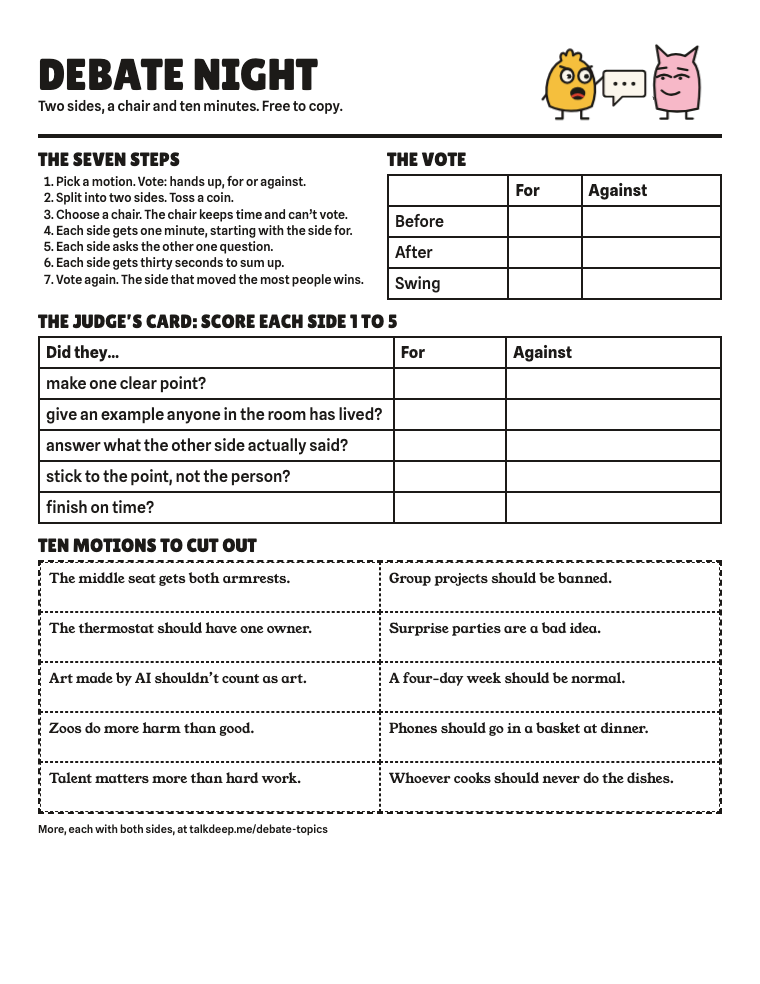
One letter-size page: the seven steps, a before and after vote tally, a judge’s scoring grid and ten motions to cut out. Free to copy, print and adapt for teaching. Each audience set above also prints with both sides.
Download the printable (PDF)
How to run a debate at a table
You need two sides, a chair and about ten minutes. It works with four people or fourteen. Run it from the tool below, or follow the steps.
Run it from this page
Put a phone in the middle of the table. It deals a motion, keeps the clock and works out the swing. Nothing is stored.
- Pick a motion and take a vote: hands up, for or against. Write the numbers down.
- Split into two sides. Toss a coin, because arguing for something you don’t believe is half the fun.
- Choose a chair. The chair keeps time, stays neutral and can’t vote.
- Give each side one minute to make its case, starting with the side for the motion.
- Let each side ask the other one question.
- Give each side thirty seconds to sum up.
- Vote again. The side that moved the most people wins, whatever the totals say.
How to argue a side you don’t believe
This is where a debate gets good. Find the strongest honest reason someone could hold the view, not the silliest one. Say it in one short sentence, then give one example anyone in the room has lived through. Don’t pile up five weak points when one strong one will do. And listen to the other side, because your best moment is answering what they actually said. Going after the person, or changing the subject, may get a laugh, but it doesn’t answer the point. The game tests you on exactly that.
How the game works
- Read the motion: the sentence up for debate. Pick a side, and the other side fires back its best line.
- Read it, then hold the line or cross the floor. Reading earns standing, and the first time you truly change your mind earns the most.
- Act faster than you could read and the chair takes standing away. Run out and you’re thrown out of the house.
- Answer back once a round: pick the reply that answers the point, not the person. The other side also reads your own votes back to you.
- At the end, two lines you stood against come back. Concede one or concede nothing, and get your verdict.
- Today’s motion is a one-card round with its own result. Or pass the phone to a friend, or send a dare: the higher standing takes the floor.
Debate words, in plain English
You don’t need any of these to have a good argument, but it’s fun to sound official.
- Motion: the statement up for debate.
- This house believes, this house would: the traditional way to open a motion. The first states a belief, the second proposes an action.
- Proposition and opposition: the side for the motion and the side against it.
- Rebuttal: answering what the other side just argued.
- Steelman: the strongest version of a view you disagree with. It’s the opposite of a straw man.
- Crossing the floor: a parliamentary phrase for changing sides. At Westminster it means leaving one party for another. In our game it just means someone made a better point.
- Oxford-style debate: the audience votes before and after. At Intelligence Squared debates, the side that shifts the most votes wins, which is the idea behind the last step above.
- Division: a counted vote. In the UK House of Commons, members vote by walking through the Aye lobby or the No lobby.
Who wrote this, and how to use it
Written by the independent developer behind Talk Deep, a card game for good conversations.
How it’s made: every motion is original, tested against one question: could its line make a reasonable person think again? Lines are reasons, not statistics. Where a case states a fact, it links its source.
What’s left out: politics, religion, health, and anything about children.
For teachers: copy, print and adapt the motions and cases for teaching, free, with a credit to talkdeep.me.
Corrections: hello@talkdeep.me. Last checked November 6, 2026.
Questions people ask
What are some good debate topics?
The best ones are small, specific and arguable from both sides. Try whether every exam should be open book, whether art made by AI should count as art, or whether autocorrect does more harm than good.
What are good debate topics for students?
Pick motions that need no research to start, like whether group projects should be banned, whether phones belong in the lecture hall or whether talent matters more than hard work. For older students, add a real trade-off, such as whether zoos do more harm than good.
Are these debate topics suitable for school?
There’s no politics, religion or health here, and nothing about children. The classroom set is written for college and adult classes, so read it first if you teach younger students.
What are some fun debate topics for friends?
Anything with nothing at stake: pirates against ninjas, one horse-sized duck against a hundred duck-sized horses, or whether a haunted house is a fair price for an ocean view. The sillier the topic, the harder people argue.
What are funny controversial questions?
Questions that split a room over something that doesn’t matter, like who should load the dishwasher or who gets the middle armrests. They give you the fun of a fight without the fight.
What’s the difference between a debate topic and a motion?
None, really. A motion is a debate topic written as one clear statement that a side can be for or against, such as “The thermostat should have one owner.”
How do you run a debate with friends?
Pick a motion, vote, split into two sides and choose a chair to keep time. Each side gets a minute to argue and thirty seconds to sum up. Then vote again: the side that moved the most people wins.
What does crossing the floor mean in the game?
After you pick a side, the game shows the other side’s best line. If it gets you, you cross the floor. The first honest crossing earns the most standing, and the house’s patience for more runs out quickly.
What is standing in the game?
Your score, and the thing you can lose. Reading and holding earns it, a good reply earns more, and acting without reading costs it. Lose all of it and the chair throws you out.
Can I play with a friend?
Yes. Pass one phone between you, or send a dare after a round. A dare opens on your hill with the same motions, and the higher standing takes the floor. Your first name is optional.
Do you keep my answers?
Your first vote on each motion is counted anonymously: we keep the totals, not who voted. Your crossings, verdict and record stay on this phone. If you send a dare, your first name if you gave one and your answers are kept for 30 days so your friend can compare, or they travel inside the link itself.
More games